Illustrative parcel photograph, not a record of a particular retailer order or delivery.
“Partially shipped” usually means that some of an order has been dispatched while the rest has not. The useful check is at item and quantity level: which products are assigned to each parcel, which tracking numbers exist, and what remains outstanding? The label alone does not prove that an item is lost, cancelled or about to arrive.
Retailers use their own order-status systems. A split delivery can be routine, but it still needs a clear explanation for the unshipped remainder. Keep the order confirmation, shipping notices and any promised dates together before contacting support. Do not place a replacement order solely because the first parcel arrived without everything.
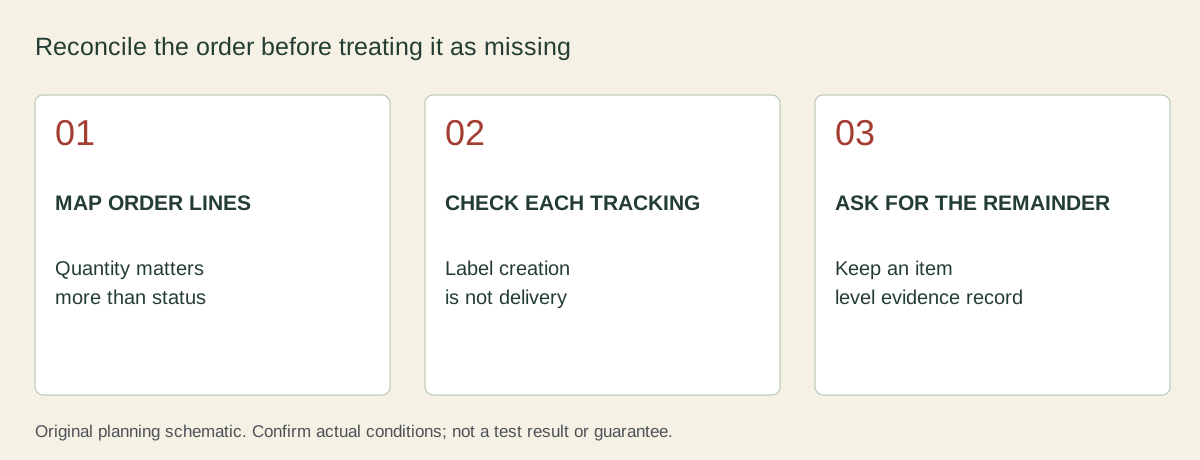
Map the order before interpreting the label
Write each product, variant and quantity from the confirmation. Match it to a parcel notice where one exists. Two identical items may be split between boxes, while several items can share one tracking number. A bundle can also contain multiple components despite appearing as one order line.
| What you can see | What it establishes | What remains to check |
|---|---|---|
| One shipping notice for several order lines | The retailer has assigned some items to a shipment | Which exact quantities are included |
| Label created | A shipping label or tracking record exists | Whether the carrier has received the parcel |
| One parcel delivered | That parcel reached its recorded delivery state | Whether all ordered items were meant to be inside |
| Remaining item has no tracking | No tracking is shown for that remainder | Dispatch plan, revised date or available cancellation route |
The table is a reconciliation aid, not a translation of every retailer's status labels. Check the retailer's own explanation for the actual order. For example, Fourthwall's partial-shipment explanation describes its own split-order process; it does not define another shop's fulfilment promise.
A fictional two-parcel example
Suppose an order contains two mugs and one notebook. The first notice lists one mug, while a second notice lists the other mug and notebook. The first delivered box can be complete for that shipment even though the whole order remains incomplete. Record the delivered quantity as one mug, not “order received.”
If the second notice lists only the notebook, one mug remains unexplained. Ask the seller for the planned dispatch or resolution for that exact quantity. A generic tracking link is not enough to reconcile it. These quantities illustrate the method; they do not describe a real merchant's order.
Separate delay, missing contents and damage
An item not yet assigned to a shipment is different from an item listed on a delivered parcel's packing slip but absent from the box. Record the packaging and contents before discarding them if the latter occurs. For damage, use the delivery evidence checklist so the support request identifies the actual problem.
Check promised dates for each shipment rather than assuming the first parcel's delivery estimate applies to the remainder. The delivery-promise check can help you keep the seller's wording separate from a carrier estimate. Do not assume a label-created scan means the carrier has the goods.
Ask support an item-level question
Send the order reference, affected item and quantity, the relevant parcel number and the date you checked. Ask which parcel contains the remainder or what dispatch date and resolution options are available. Keep screenshots of the answer and any revised promise. Use the merchant's verified account or support channel rather than a phone number from an unsolicited delivery text.
Cancellation, refunds and dispute deadlines depend on the seller's terms, payment route and applicable law. Check the relevant terms and deadlines promptly when a promise is missed. This guide does not establish a universal right to cancel the whole order or guarantee that a payment dispute will succeed.
Use the parcel reconciliation sheet
Open the partially shipped order working sheet. It has separate columns for ordered quantity, parcel assignment, delivered quantity, remaining quantity and the seller's next action. Type into the blank cells and print or save a PDF before closing; entries are temporary and are not sent to the website.
Order reference / item and variant:
Quantity ordered:
Parcel reference / quantity assigned:
Quantity delivered / quantity still unexplained:
Promised date and source:
Seller's answer / next action / follow-up date:
Keep the record until the whole order is reconciled or the outstanding portion is resolved. A status label is a starting point for checking evidence, not a substitute for the item list, the seller's commitment or the applicable consumer rules.