Return shipping costs depend on the seller, the item, the reason for the return and the return route you use. Before sending a parcel, separate the postage you pay now from any label fee deducted later, then check whether other charges affect the amount you expect back. A return being accepted does not, by itself, tell you the final refund.
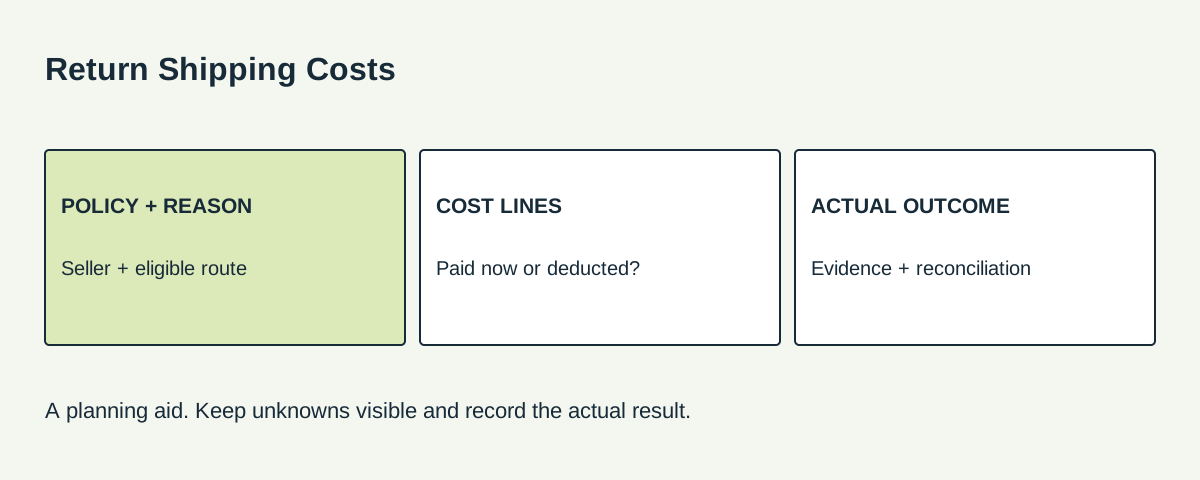
Use this original return-cost record to put the policy, estimated amounts and actual outcome beside one another. It is a blank planning sheet, not a refund calculator with access to your order. Do not enter passwords, full payment-card numbers or other unnecessary account details.
Identify the seller and the reason first
Open the actual order, not just the store's general homepage. Record the selling business, the item, the purchase date and the return reason. A marketplace seller, partner concession or international order may have different instructions from items sold directly by the platform.
Describe the problem accurately. A change of mind, wrong size, damaged delivery and incorrect item can lead to different return routes. Do not choose a false reason to obtain a cheaper label. If the instructions do not explain your situation, ask through the official order-support channel before paying postage.
The California Attorney General's refund-policy guide advises reading the seller's policy before buying and notes that restocking charges, receipt requirements and final-sale exclusions can matter. That page also discusses California-specific rules. This article uses the policy-checking guidance, not a claim that California law applies to every reader or establishes one universal refund entitlement.
Split the possible costs into separate lines
A single line marked “return fee” can hide several different questions. Make one row for each amount and record whether it is quoted, estimated, confirmed or already charged. If an amount is unknown, leave it unknown rather than entering zero.
| Cost line | Question to resolve | Where to record the answer |
|---|---|---|
| Return postage | Do you buy shipping yourself or use the seller's label? | Carrier quote or return instructions |
| Label deduction | Is a label fee taken from the refund? | The order's return summary |
| Restocking or handling | Does a separate charge apply to this item and reason? | The relevant policy and support reply |
| Original delivery | Is any original delivery charge refunded? | Refund explanation for this order |
| Other adjustments | Are discounts, tax, exchange charges or payment conversion involved? | Itemised refund statement |
A prepaid label is not necessarily free: the seller may supply it first and deduct an amount later. Equally, a carrier quote you obtained yourself is not automatically the price of the seller's label. Use the applicable route and do not count both as if you had paid both.
Work through the arithmetic without promising an outcome
Here is an invented example, excluding tax and currency conversion. You originally paid USD 80 for an item and USD 5 delivery, so USD 85 left your account. Suppose the confirmed return calculation starts with USD 80, deducts a USD 7 label fee and a USD 3 restocking fee, and does not return the original delivery charge. The refund would be USD 70 under those assumptions. USD 15 of the original payment would not come back.
If you instead pay the USD 7 postage separately and the merchant deducts only the USD 3 fee, the merchant's refund would be USD 77, but you have also spent USD 7 on postage. The net recovery is still USD 70 in this example. These are different cash movements and should appear on different lines.
Your order may use a different calculation. Do not subtract a fee twice because it appears in both a label receipt and the refund explanation. Save the itemised figures and ask which amounts are deductions and which were paid separately.
Compare only the return routes actually offered
The available choices might include a store, a designated drop-off point, collection or shipping. Check whether your specific seller, item size, condition and location qualify. A store accepting its own stock does not prove it can accept a partner seller's order.
If two valid routes are available, compare the confirmed charges, packaging requirements and the practical journey. A no-postage route can still require time or transport. Keep those personal costs separate from merchant deductions; they do not change the refund amount unless the seller explicitly says so.
Check whether the deadline refers to starting the request, handing over the parcel or its arrival. If that is unclear, ask. Our delivery-promise guide deals with the separate delivery stage, rather than replacing return instructions.
Keep the handoff evidence and reconcile the result
Follow the approved return instructions. Save the authorisation or case reference, the label, relevant item and packaging photographs, and any acceptance receipt or tracking reference. A label being created is not the same event as the parcel being accepted or the seller completing its review.
When a refund is issued, compare the actual statement with the confirmed estimate. Record the method, amount and any unexplained difference. Use the official support route for discrepancies and share only the details needed there. Do not assume a pending refund is lost or promise yourself a completion date that the seller has not given.
Before your next purchase, read the shipping-cost guide alongside this return check. One concerns getting the item to you; the other concerns what happens if it needs to go back.
Sources checked 15 October 2026. Where We Shop has not placed a test order or verified a particular customer's refund. This page organises the questions and arithmetic; the applicable seller instructions and relevant consumer protections still need to be checked for your situation.